If you run a painting or coating company, you have felt this one.
A sales rep calls. They promise 40 ready-to-buy leads a month. You sign the agreement.
Three weeks later you are calling homeowners who already hired somebody else, and you’re paying for every one of those calls.
The problem is not that you picked the wrong vendor. The problem is that nobody ever showed you how these companies actually make money.
This post compares nine lead sources for painting and coating contractors. What each one costs, whether the lead is yours alone, what you sign, and who it actually fits.
One thing up front. This post covers channels you can switch on without much effort.
That leaves out four of the most lucrative channels: SEO, paid search, paid social, and email marketing all take more energy and expertise to run well, so they get their own posts.
We put ourselves on the list and answered the same four questions.
Let’s get into it…
The Quick Answer
Now the detail behind those picks.
How We Picked These Nine

Every option below gets judged on the same four questions.
One note on the numbers below. Almost none of these companies publish a rate card.
The ranges you will see are what agencies and painting contractors report paying. Treat them as a starting point for your own math, not a quote.
1. Google Local Services Ads
Google verifies your business, then puts you above the paid ads and the map results.
Here’s the catch: Approval can take a few weeks. Background checks, insurance, and license paperwork all get reviewed before a single ad runs. More importantly, your Google Business Profile must be competitive with a relatively high number of reviews compared to your local competition.
Your Google Business Profile feeds this channel too. Reviews and response time affect where you show up, so a thin profile gets buried by the shop down the road.
If you sell concrete coatings, check the category list before you build a plan around this. Coating work does not always fall where you would expect.
2. Niche Marketing Partner

Yes, you are reading about lead generation on a niche marketing agency’s website. That looks biased and you should treat it that way.
So hold this entry to the same four questions as the other eight, and check the numbers yourself.
Here’s the catch: This one is the exception on the list. It is not a channel you switch on. It is what you build so the channels above stop being your only option, but that’s inherently what makes this the best long-term marketing solution.
The ceiling is also different. Every other entry caps out at whatever inventory the vendor has in your zip code. This one grows with the work you put into it.
That input is the trade. The marketing gets built around your crews, your services, and your market, so it needs your photos, your numbers, and your time. Nothing here is cookie-cutter.
3. Angi Leads (Formerly HomeAdvisor)
The biggest name in contractor leads, and the one painting contractors complain about most.
If you knew this as HomeAdvisor, it is the same company. HomeAdvisor folded into Angi and the contractor side is sold as Angi Leads now.
Here’s the catch, and it is on the public record. In 2023 the Federal Trade Commission finalized an order requiring HomeAdvisor to pay up to $7.2 million.
The FTC alleged the company made false or unsubstantiated claims about lead quality. It also alleged the company told service providers its leads turned into jobs at rates it could not support.
Membership at the time ran $287.99 a year. That was owed before a single lead arrived.
These predatory tactics should be considered when evaluating fit for your painting or coating company.
4. Thumbtack
A marketplace where homeowners browse profiles and pick who to message.
Here’s the catch: There is no cost barrier for homeowners, so you will meet more price shoppers. Your estimate process has to sell value, not the lowest number.
Commercial painting contractors will find thin volume here. Property managers are not shopping on Thumbtack.
5. Yelp
Still underrated by painting contractors who wrote it off years ago.
Your profile does the selling on Yelp. Photos and reviews matter more than your ad budget.
Here’s the catch: Yelp has a history of predatory tactics, including suppressing negative reviews, but only if you keep paying their monthly fee.
This channel performs best along the West Coast and in large metro areas where it’s widely adopted by the local market, so results can be hit or miss.
6. Networx
A pre-screened lead marketplace covering remodeling and home improvement trades.
Painting volume is thinner than the roofing and remodeling categories. Treat it as a supplement to in-person networking.
7. Nextdoor
Neighborhood social, and painting is one of the things neighbors actually ask about.
Here’s the catch: Reach is capped by neighborhood. Nextdoor is a supplement, not a primary channel.
Similar to Yelp, some markets perform very well on this channel, while others are crickets.
Also, since your reputation drives most of the results on this channel, consider the opportunity cost of pulling reviews from a channel you own, such as your Google Business Profile, which can negatively impact your long-term results.
8. Bark
A broad marketplace where you buy credits to contact a lead.
Contractor reviews of Bark run much harder than homeowner reviews of it. Test small if you test at all.
9. Houzz Pro
Part software, part lead source, built around design-led projects.
Five Questions to Ask Before You Sign
Every rep on this list is trained to answer the questions you already know to ask. Ask these instead.
- 1How many other painting contractors get this same lead? If the answer is a range, assume the top of the range. If the rep will not put the number in writing, that is your answer.
- 2What is the actual term, and what does it cost to leave? Verbal promises hold no weight. If the rep says you can cancel anytime and the agreement says twelve months, the agreement wins.
- 3What is your refund process for a bad lead? Ask how many requests get approved and how long it takes. A generous policy nobody can use is not a policy.
- 4What is my total cost before I book my first job? Add the membership, the deposit, and the minimum spend. Most painting contractors are several hundred dollars in before a homeowner picks up.
- 5Who owns the phone number? If the vendor owns the tracking number, your call history leaves with them when you cancel.
A good vendor answers all five in plain language. The ones who get uncomfortable around question one are telling you what you needed to know.
All Nine Compared
| Company | Reported cost | Lead type | Contract | Best for |
|---|---|---|---|---|
| Google LSA | ~$20 to $50 per lead | Exclusive | None | Most residential painters |
| Niche marketing partner | Monthly fee | Owned and exclusive | Quarterly or annual | Painters building an asset |
| Angi Leads (formerly HomeAdvisor) | Annual membership plus $15 to $120 per lead | Shared, 3 to 8 pros | 12 months | Brand new, no reviews |
| Thumbtack | ~$25 to $75 per contact | Shared | None | Tight budgets, new markets |
| Yelp | Free requests, ads ~$30 to $150 per lead | Shared | Varies | Metro shops with reviews |
| Networx | ~$15 to $150 per lead | Both | Flexible | A second source |
| Nextdoor | ~$2.50 to $3.50 per click | Exclusive | None | Suburban repeat work |
| Bark | Credit packs | Shared | None | Rarely a fit |
| Houzz Pro | Monthly subscription | Inbound | Monthly or annual | Cabinets, specialty finishes |
Reported ranges from agency and contractor sources, not vendor rate cards. Your market will move these numbers.
Shared, Exclusive, or Owned
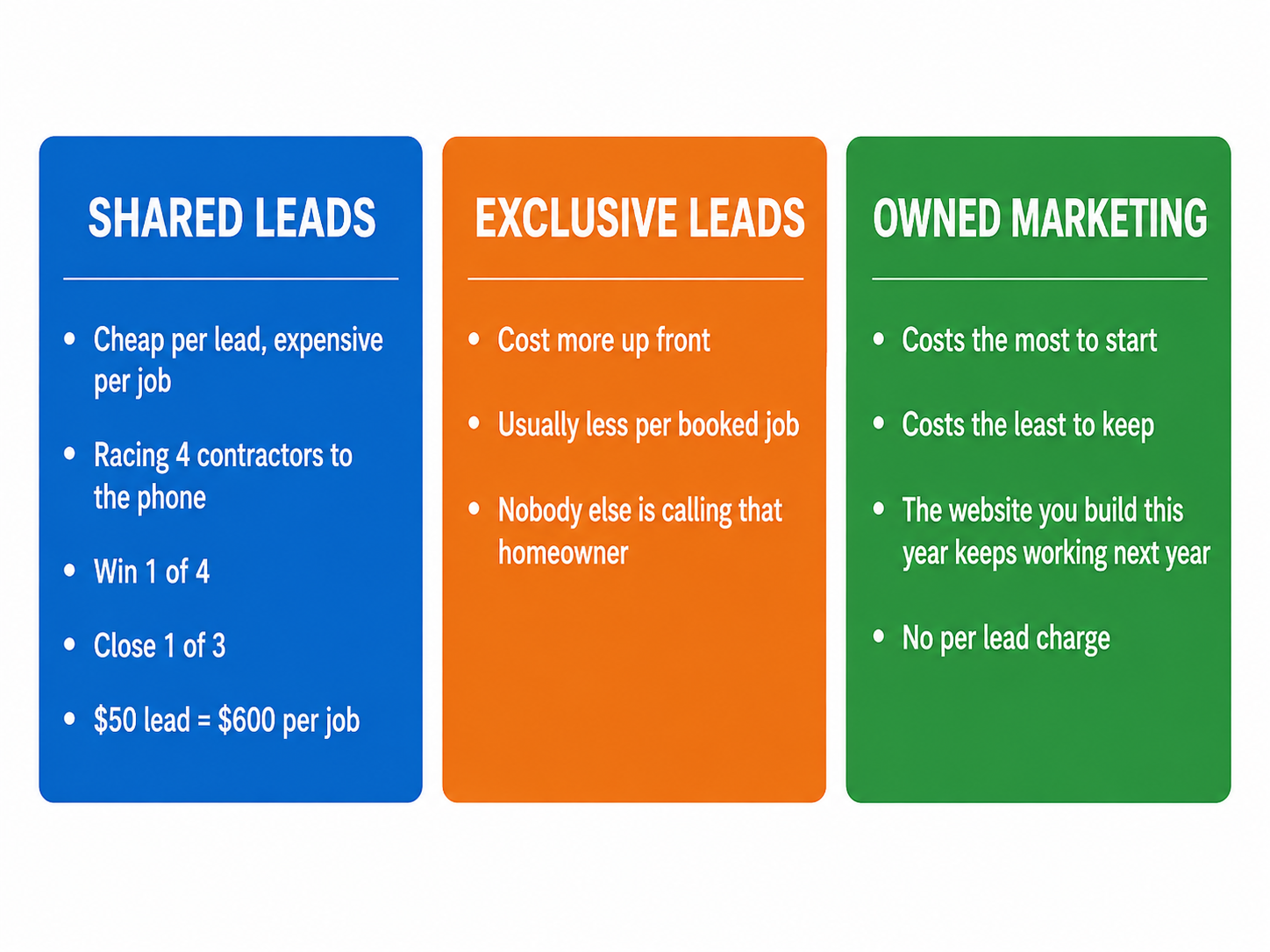
Every option above lands in one of three buckets. That is the decision you are actually making.
One more thing that gets missed. Almost every company on this list is built for residential work.
If you run commercial painting jobs, none of these marketplaces will bring you a property manager or a general contractor. That work comes from relationships, bid boards, and being findable when somebody searches for a commercial painting contractor in your city.
Concrete coating contractors sit in a similar spot. The category exists on paper. The volume behind it usually does not.
The bottom line: most painting contractors do not need to pick one bucket. They need to know which bucket each dollar is sitting in.
We broke the first two down further in our post on shared leads for painting contractors.
What to Do Next
Pull your last twelve months. Count booked jobs from every source. Divide what you spent by what you booked.
Most painting contractors have never run that number. The ones who do usually find one channel quietly eating a third of the budget for a handful of jobs.
You do not need nine lead sources. You need to know which two are working and which one is bleeding.
Then set a floor. Decide what you can pay per booked job and still make money.
Any channel over that number gets ninety days to fix itself or gets cut. That one rule does more for most painting contractors than switching vendors ever will.
If you want a second set of eyes on it, we will look at your numbers and show you where the waste is.
More ways to fill the schedule are in our posts on painting leads and free painting leads.
Resources
FTC order against HomeAdvisor: Read the full announcement and settlement terms.
Google Local Services Ads: Check the current screening and category requirements.