If you are a painting contractor with a website, you have probably felt this.
You asked three companies for a quote. One said $500. One said $6,000. One said $28,000.
All three used the same word: Website.
And somewhere in the middle of it, somebody told you your site now has to show up in AI too.
So now you are not sure whether you are buying a website or falling behind.
That is where most contractors get stuck.
Not on the price, but on the fact that nobody explains what the price actually buys.
It is like getting three quotes on a repaint when nobody compared what’s included in each.
This article gives you real numbers by tier, what pushes those numbers up and down, and the warning signs on both ends of the range.
You will also get the questions to ask before you sign anything.
Let’s get into it…
The Quick Answer
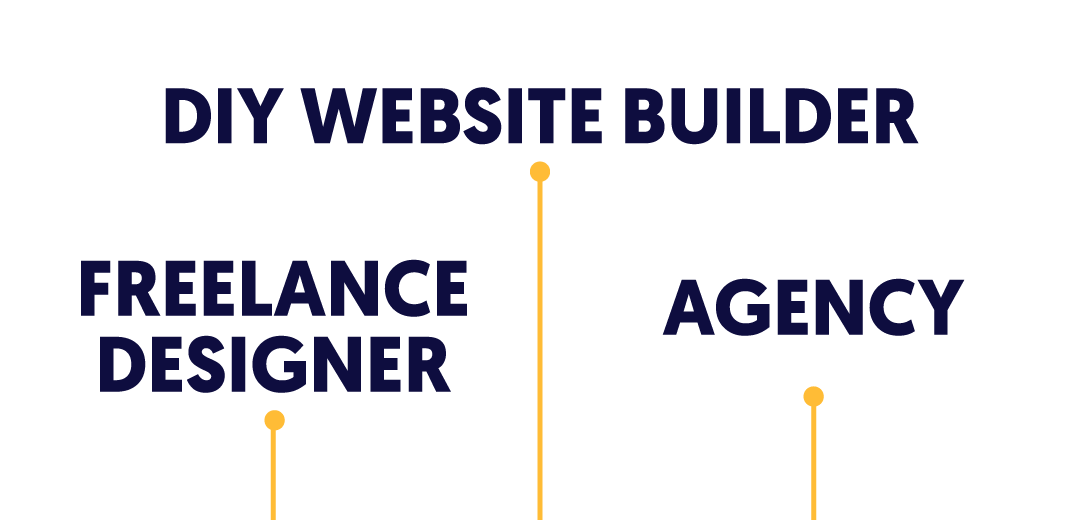
Here are the three routes and what each one runs.
| Route | Typical cost | Timeline | What you end up with |
|---|---|---|---|
| DIY website builder | $10 to $99 per month | A day to a week | A site that exists. You write the copy, pick the template, and handle updates yourself. No interview, no schema, no tools. |
| Freelance designer | $500 to $5,000 one time | 2 to 6 weeks | A custom-looking site. Quality swings hard based on who you hire, and support ends at launch. AI readiness depends entirely on whether you asked for it. |
| Agency | $5,000 to $30,000 and up | 1 to 3 months | Strategy, an interview-driven copy process, design, build, schema markup, and support after launch. AI readiness should be included. Confirm that it is. |
Those ranges come from current small business website pricing data.
Here’s the thing: the software is not what you are paying for.
WordPress is free. Templates are cheap.
The money goes to the people making decisions about what the site says and who it is built to attract.
Read that again.
What Actually Drives the Price

Seven things move the number. Almost none of them are visual.
Page count
A five page site and a forty page site are not the same project.
Most painting contractors need more pages than they think.
Service pages for interior, exterior, cabinets, and commercial work.
Separate pages for each city you serve.
Concrete coating contractors need the same structure for garage floors, patios, and industrial work.
Copywriting
This is the single most underpriced part of a website quote.
If nobody asked who writes the words, the answer is usually you. Or worse, a template with your city name pasted in.
Here is a test you can run in ten seconds.
Does the page still make sense?
If a competitor’s name fits in your copy without breaking anything, that copy is not about you. It is about painting contractors in general.
That is a proof problem, not a style problem.
It is also why real onboarding involves a lot of questions.
The answers are the only thing a competitor cannot copy.
Most companies building websites skip this step.
Generic copy is faster to write and cheaper to produce.
You are paying for the questions, not the word count.
Here is the part most people miss.
That same test decides whether AI ever mentions you.
Search Everywhere Optimization
That is what we call it, because AI exists now. Same work, wider target.
Some quotes include page titles, meta descriptions, header structure, image alt text, site speed, and mobile layout.
Some charge for all of it separately. Ask which one you are getting.
Then ask about AI.
Two acronyms are floating around right now.
AEO stands for Answer Engine Optimization.
GEO stands for Generative Engine Optimization.
Both describe the same goal. Showing up when somebody asks ChatGPT or Google’s AI for a painter recommendation.
Straight talk: AI search is still a small slice of total search volume. Anyone telling you it has replaced Google is selling you something.
It is growing, though, and this work takes months to pay off.
Building it into a new site costs far less than bolting it on two years from now.
Here is what these tools actually need from your site.
Here’s the thing: AI cannot write what it does not know. So publish the things AI cannot write without you.
A page of general advice about interior painting has been written a thousand times already. Nothing gives an AI tool a reason to cite yours.
A page with your numbers on it has no competition.
We covered how this works in our full breakdown of search optimization for painters.
Self-service tools
Buyers want answers before they talk to anyone.
These cost real money to build. Usually a few hundred to a few thousand dollars each.
They also do two jobs at once.
They capture people who are not ready to call, and they give search engines and AI tools something no competitor page has.
Ask whether your quote includes any. Most do not.
So what does all of that add to the price?
Almost nobody itemizes it. It gets buried inside one build number.
That is a big reason three quotes come back so far apart.
So make them itemize. Ask every company you talk to for a separate price on these four lines.
Two builds priced at $8,000 are not the same build if one includes all four lines and the other includes none.
Now the gap between $500 and $28,000 has an explanation.
You are no longer comparing prices. You are comparing what the price contains.
Photo and video
Painting and coating work is visual.
Stock photos of somebody else’s kitchen do not close jobs.
A real photo shoot runs $500 to $2,500.
Most contractors already have hundreds of usable job photos on their phone.
Integrations
Estimate booking. Call tracking. CRM connection. Financing applications. Chat.
Each one adds cost.
Each one also removes a step between a visitor and a booked job.
Ongoing care
Your cost does not stop at launch. Hosting, domain renewal, security updates, and content changes are recurring.
Basic care plans run $50 to $150 a month. Full-service plans run higher.
What a Lead-Generating Site Has That a Brochure Site Doesn’t
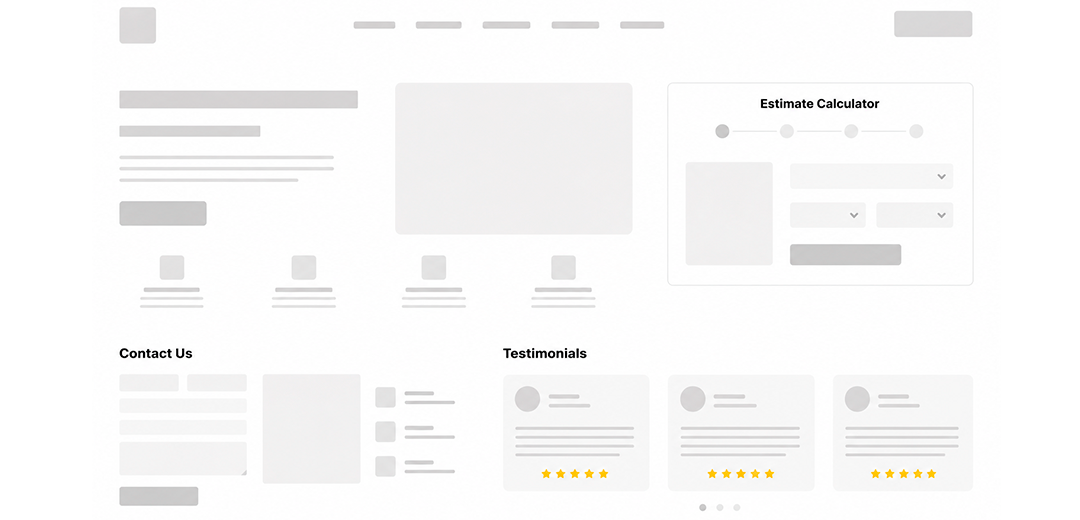
A brochure site is a business card on the internet. It lists your services, shows a few photos, and has a contact form at the bottom.
It looks fine. It books almost nothing.
A lead-generating site is built around one job. Turning a visitor into a scheduled estimate.
Here is what that looks like in practice.
We broke the full list down in the elements your site needs to turn traffic into painting leads and in ten ways to build a painting website that generates leads.
Here’s the catch: none of that shows up in a design mockup.
Two sites can look identical and perform nothing alike.
Overpaying and Underpaying: The Warning Signs

Both ends of the range have traps. The cheap end has more of them.
Signs you are underpaying
Wrong assumption most contractors make: that a cheap site is a small loss.
It is not. A $2,500 site that books nothing costs you every job it failed to capture.
Run that over eighteen months and the number gets ugly.
Signs you are overpaying
Where Base Coat Marketing Falls

Fair question, so here is the straight answer.
We do not sell websites on their own.
We build custom sites for residential painting contractors, commercial painting contractors, and concrete coating contractors, but the site comes inside a marketing program. You own it either way.
Plan on budgeting at least $3,000 to $5,000 a month, and that number includes your ad spend.
That is not the cheapest option on this page. It is not meant to be.
Here’s the thing: if all you want is a website, we are not your fit. A freelancer will serve you better and cost you less.
We are a fit when the website is one piece of a system that also includes search, ads, and tracking, and when you want one team accountable for the whole thing.
We also ask a lot of questions before a single page gets written, because that is the only way to speak on your behalf instead of writing about painting contractors in general.
We would rather tell you all of that now than three months into a contract.
Questions to Ask Before You Sign Anything

Take these to every quote you get, including ours.
If a company gets uncomfortable with that last question, you have your answer.
The Bottom Line
There is no single right price for a painting contractor website.
There is a right price for what you need it to do.
If you need a place to point people who already know your name, a builder or a freelancer will handle that for a few hundred dollars.
If you need the site to produce booked estimates on its own, month after month, you are buying strategy and content and tracking.
That costs more, and it should.
The mistake is buying the first thing and expecting the second.
And whichever way you go, make sure the words on the page could only have come from you.
That is what earns a ranking now, and it is what gets you cited by AI tools later.
Want to know what your current website is actually producing, and what it should be? Our Growth Audit shows you where your leads come from, where they leak, and what it would take to fix it.
Resources
Leadpages, average cost of website design for small business: See the full pricing breakdown by build type.
WebFX, website costs: Read their rundown of build and maintenance pricing.