If you are a commercial painting contractor, you already know who you want to work with.
The property management firm with 30 buildings, the general contractor who handles every renovation in town, or the facility owner whose exteriors are overdue.
You know the names and still can’t get them on the phone.
Here’s a real-world, proven solution for this problem: It’s called gift outreach.
If you’ve tried gift outreach before, I promise this strategy has nuances you likely haven’t tried.
Let’s get into it…
What Gift Outreach Actually Is

Commercial painting has a cold start problem.
Residential buyers search for you. Commercial buyers already have a painter, and they are not looking.
So you need a way that is not a cold call and not a bid request.
Gift-based outreach is simple. You give something small and memorable to a specific person before you ask them for anything at all.
Here’s the thing: The gift is not a bribe and it is not a sales pitch. It is permission to call again.
That is all you are buying. A reason the second call is not cold.
Step 1: Build Your Dream 100

Start with your ICP (Ideal Customer Profile).
Who do you want to work with? More importantly, who do you like working with?
Solidify your ICP details and communicate everything to your team. Everyone should know who they want to work with, and what a good fit for the company looks like.
Next up: Find every business that fits your ICP criteria in your service area.
Make a list using your GrokBot, or by hand using Google and a spreadsheet. All 100 companies, sorted and prioritized.
This is the top 100 general contractors, property management companies, government facilities, hospitals, or whatever type of business fits your ICP, that if they hired you, would make all of your problems go away.
Write down the company, the building or portfolio, the person’s name, their title, and the address.
If you cannot name a person, that row is not finished yet.
Here’s the catch: Most contractors skip this part because it is boring. It is also the only part you can’t buy, because it’s specific to you and your business.
A Few Ideas For Choosing The 100
There is no rule here. The list is yours.
That said, these filters tend to help contractors sort faster:
You can find most of these names through county property records, local commercial bid boards, and your area property management associations.
Your past customers will also tell you who manages their building. You just have to ask.
Step 2: Pick A Gift They Will Remember

We recommend Apple Cookie & Chocolate Company.
For under $2,500 you can buy 100 branded paint cans filled with cookies. That works out to about $25 per account.
Tape a business card to the top of each can.
A paint can is the right pick for a reason. It looks like what you do. It sits on a desk instead of going in a drawer.
Cookies get shared with the office. Your name gets repeated out loud. A branded pen in a desk drawer does none of that.
Compare it to where that same money usually goes:
| Spend | What you get | What you do not get |
|---|---|---|
| Shared commercial leads | Bids you split with three other painting contractors | Any relationship after the bid |
| Branded swag drop | Pens and hats in a supply closet | A named person to call |
| Dream 100 gift drop | 100 named decision makers who know your company | An instant contract |
Step 3: Know The Gift Rules Before You Deliver
This is the part most gifting advice leaves out, and it is the part that can get you removed from a bid list.
Plenty of the buildings on your list are public. School districts, city facilities, state universities, and county buildings all tend to have written gift policies with dollar caps.
Federal rules show how tight those caps get. Under federal ethics rules, an employee may accept unsolicited gifts worth $20 or less per source per occasion. The total from any one person cannot pass $50 in a calendar year.
Cash and investment interests are never allowed under that exception.
Here’s the catch: A $25 can of cookies is already over the federal line. Public buildings are where this play gets you disqualified.
Three rules that keep you safe:
- Call the front desk first. Ask about their gift policy before you deliver. It takes two minutes.
- Wait out open bids. If you are in an active bid with them, hold the gift until it closes.
- Never send cash or a general use gift card. Not once, not at the holidays.
Private general contractors and property management firms are usually looser. Many still have internal policies. Asking costs you nothing and it makes you look like a professional.
One tax note. The IRS lets you deduct no more than $25 of the cost of business gifts you give directly or indirectly to each person during your tax year.
Items costing $4 or less with your business name permanently engraved, handed out regularly, do not count toward that limit.
Talk to your CPA about how to book the spend.
Step 4: Deliver Them Yourself

IMPORTANT: Drive them. Do not mail them.
A box on a loading dock is a box. A person walking into the lobby with a paint can is a visit.
You will not get past the front desk at every stop. That is fine.
The receptionist takes your name, your card goes on the right desk, and you now have something true to say on your next call.
You were there. You met someone. You left something behind.
Step 5: The Follow-Up Is Where This Works
Here is where almost every contractor wastes the $2,500.
They deliver 100 cans, make a dozen calls, hear nothing, and decide gifting does not work.
Gifting worked. The follow-up never happened.
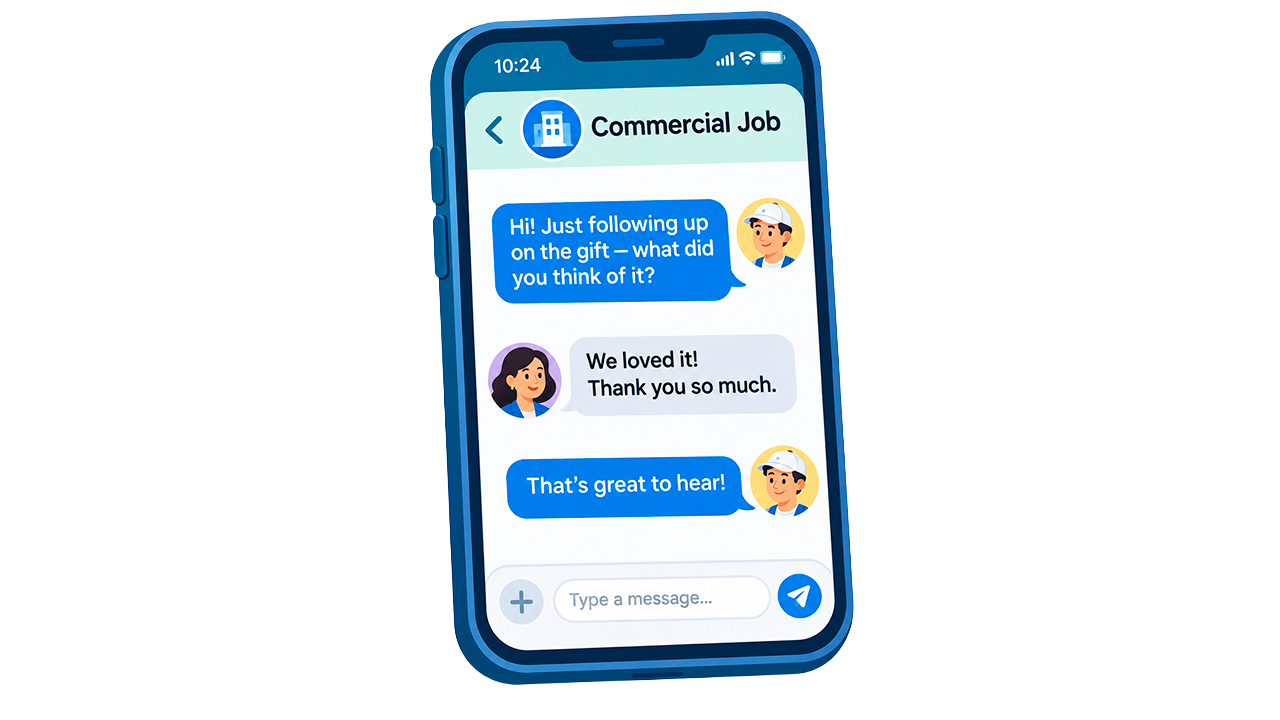
You now have a reason to call that is completely true. You were at their building. You left something. You are calling to make sure it got to them.
Build a simple sequence and run it on every one of the 100:
| Day | Channel | What you say |
|---|---|---|
| 1 | In person | Drop the can at the front desk, leave a card |
| 3 | Phone | Reference the drop off, ask who handles painting bids |
| 5 | One photo of similar commercial work you have done | |
| 12 | Phone | Second call, same contact |
| 30 | Phone | Ask when their next repaint cycle comes up |
| Every 30 | Phone or email | Keep going until they’re ready to move forward |
Keep going until you get a yes or a no. Silence is not a no.
Our breakdown on the perfect follow-up covers the cadence in more detail.
Why Most Painting Contractors Never Do This
The real reason is not money. It is the feeling.
Driving cookies to a stranger’s office feels like begging. It feels like you should not have to do this.
So contractors wait to get invited to bid instead.
Here’s the thing: Waiting to get invited is the actual problem. Commercial painting is not a market you get found in. It is a market you get known in.
The painting contractor who shows up in person with a paint can full of cookies is not begging. He is the only one who showed up at all.
Why A Marketing Agency Is Telling You To Buy Cookies
We run ads and websites for painting contractors. Cookies are not that.
Here is why we hand this play out anyway.
Residential marketing works because homeowners search. Someone types in painters near me, and you can be there when they do.
Commercial does not work that way. A facility manager who already has a painter is not searching for a new one.
That is the whole problem. Almost nobody finds you by searching, so the list has to do the work.
Our side of this starts the moment you walk out of their lobby. The person holding your paint can will look you up before they call back.
If your site shows nothing but kitchens and front doors, the cookies were wasted.
Here’s the catch: Handing over the can only gets you looked up. Your site decides what they find when they do.
The Bottom Line
One hundred names. Under $2,500. A gift, a handshake, and a follow-up sequence you actually run.
That is the whole play.
The bottom line: The cookies are not what makes this work. The list and the follow-up are. Spend your time there.
It will not fill your schedule next week. It will build you a commercial pipeline with names in it instead of hope.
Ready To Fill Your Commercial Pipeline?
Here is what changes after one round of this.
You have 100 named people instead of a vague sense of who you should be calling. You know which ones answered. You know who to try again in the spring.
That list is an asset you own. A bid invite is not.
The contractors who never build one are still waiting for the phone to ring.
A Growth Audit looks at how commercial work reaches you now. It also shows what has to be true for a Dream 100 drop to turn into signed jobs.
That means your site, your commercial proof, and what happens between the handshake and the contract.
We also break down the wider picture in our post on getting commercial painting leads.