
Have you thought about bidding on commercial projects before?
But then you ran the numbers…
So are you stuck with residential?
Not at all.
This logic made sense five years ago, but today, you must diversify to survive.
Private equity has dumped over $31 billion into home services since 2014 🤯
Your residential competitors now include well-funded platforms with marketing budgets you cannot match.
But commercial painting runs on a different set of rules.
Rules that reward reliability over ad spend. Relationships over lead volume.
Learn how to get off the hamster wheel as a residential contractor by landing more commercial work in 2026.
Let’s jump in…
The Math Behind Commercial Projects

Residential painting has a seasonality problem.
Contractors in cold climates watch revenue drop 40-60% every winter.
Commercial work does not follow weather patterns.
A property manager repainting units between tenants does not care if it is January.
A general contractor finishing a medical office has a deadline, not a season.
The per-project revenue gap is significant too.
A typical residential exterior runs around $7,500. Two days of work. One invoice. Done.
Commercial contracts regularly hit 5-20x that number.
One relationship with a property management company overseeing 200 units can replace dozens of individual homeowner jobs.
And those relationships compound.
Homeowners repaint every 7-10 years.
Your best residential customer might call you twice in two decades.
A general contractor who likes your crew will bring you onto the next project. And the one after that.
Three Tiers of Commercial Work
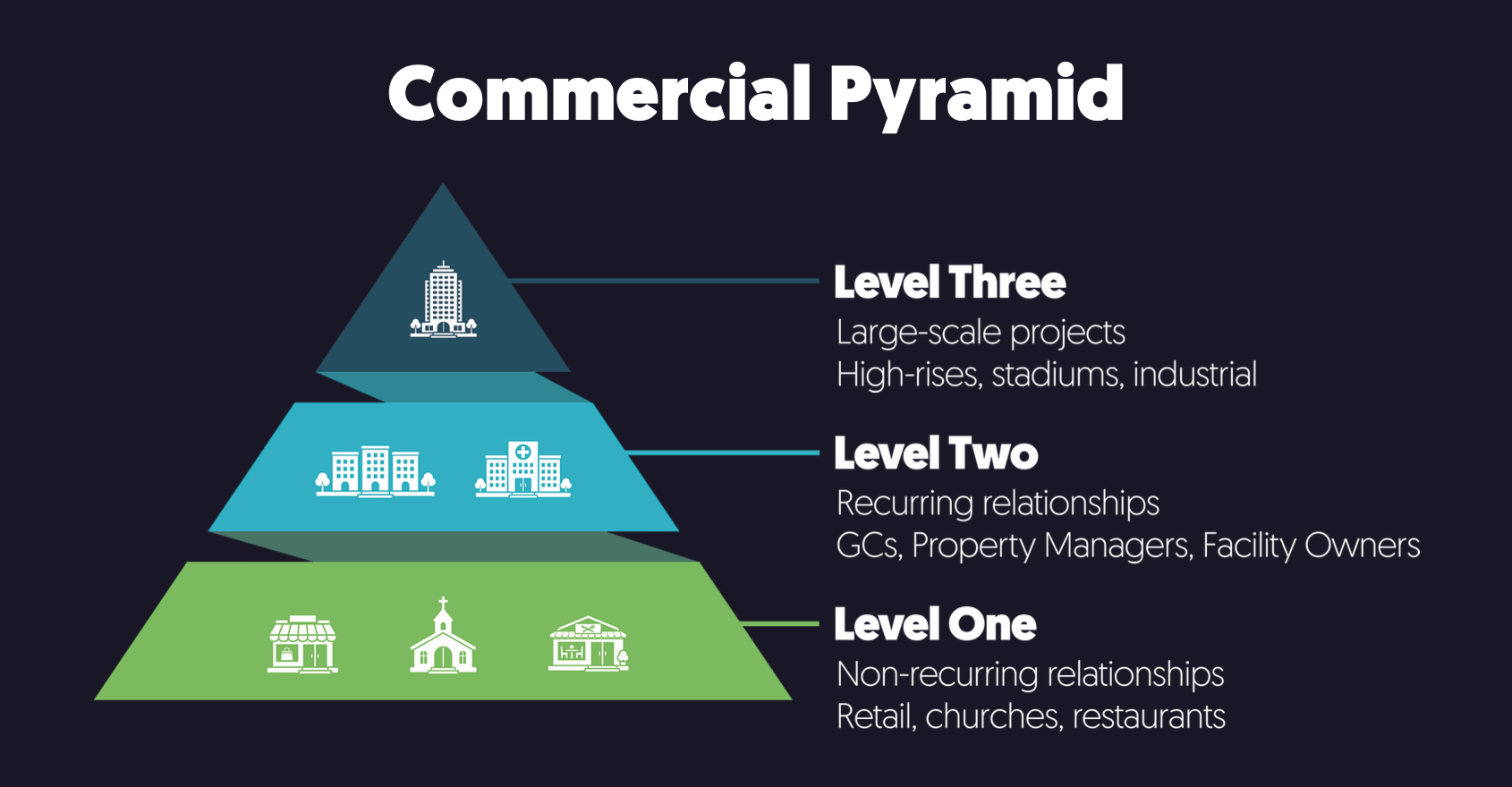
Commercial painting is not one market… It’s three.
Tier One: One-Off Commercial
These jobs pay better than residential but function the same way.
Single transactions with no built-in follow-up.
Tier Three: Institutional Scale
These require bonding capacity, specialized certifications, and years of commercial track record.
Not your starting point.
Tier Two: Relationship-Based Recurring
Here’s where it gets interesting:
This is where residential contractors should focus.
Property managers, general contractors, and facility directors who generate steady repaint volume month after month.
Look for organizations doing at least $5 million annually.
Big enough to have consistent needs and established enough to pay invoices.
Target Categories
What GCs and Property Managers Care About

Commercial buyers evaluate contractors differently than homeowners do.
Procore’s subcontractor prequalification data shows the same three factors surfacing repeatedly: track record, schedule performance, and financial health.
Your Online Presence Gets Checked First
A weak Google rating or outdated website removes you from consideration before any conversation happens.
Commercial buyers expect professional presentation because they are staking their own reputation on your performance.
Hitting Deadlines Matters More Than Price
When a GC commits to a completion date, subcontractor delays trigger a chain reaction.
A homeowner grumbles when you run two days over.
A commercial client finds a new painter.
Cash Reserves Determine What Jobs You Can Take
Commercial payment terms stretch to Net 30, Net 60, sometimes Net 90.
You finish the work in April. The check arrives in July.
Without working capital to bridge that gap, you are stuck chasing smaller jobs.
Building a B2B Outreach System

Commercial clients do not find you through Facebook ads or yard signs.
They respond to direct outreach.
Email remains the dominant B2B channel.
The approach is simple
- 1Build a list
- 2Stay visible
- 3Wait for timing to work in your favor
Start with a substantial contact list
Aim for 10,000+ decision-makers within a 60-mile radius.
Use a data provider like Apollo.io that delivers clean information.
Cheap scraped lists bounce, which damages your sender reputation.
Commit To Consistent Touchpoints
Marketing research suggests 12-15 exposures before a prospect takes action.
You are not pestering anyone.
You are staying on the radar until their current contractor drops the ball.
Use A Separate Domain For Cold Outreach
Bulk email from your primary domain risks blacklisting.
Buy a secondary domain for $20, warm it up over a few weeks, and send from there.
When it eventually gets flagged, rotate to a new one.
Skip the graphics and sales copy.
Text-only emails that speak to scheduling pain outperform polished marketing pieces.
Subject: Quick question about your painting subs
Hi Mike, I know most GCs have painters they already work with. But if your current crew ever misses a deadline or you need backup coverage, we specialize in commercial repaint work and we show up when we say we will. Happy to be your Plan B.
No images. No links. No aggressive pitch.
Just a clear offer that lands in the inbox instead of the spam folder.
Expect a Long Sales Cycle

Budget for 12 months before measuring results.
The prospects on your list already have a painting contractor.
They are satisfied. That is why your first few emails get ignored.
But satisfaction does not last forever.
At some point, their regular painter will blow a deadline. Or botch a job. Or become unavailable during a crunch.
When that happens, whoever has been consistently visible becomes the backup call.
Here’s the thing:
A year of outreach to 10,000 contacts might produce five or six real relationships.
That sounds small.
But one property management contract can generate more revenue than 40 or 50 homeowner jobs.
One GC relationship can fill your schedule for an entire quarter.
A 90-Day Implementation Roadmap

Adding commercial work does not require dropping residential clients.
It means running two systems in parallel.
Weeks 1-4: Get Your House In Order
- 1Confirm your insurance covers commercial projects.
- 2Document OSHA compliance.
- 3Audit your Google reviews and website.
- 4Buy your outreach domain and begin warming it.
Weeks 5-8: Start Sending
- 1Begin at 50-75 emails per day.
- 2Test different subject lines. Monitor open rates.
- 3Respond immediately to any reply, even negative ones.
Weeks 9-12: Expand Volume
- 1As deliverability holds, increase your daily sends.
- 2Build follow-up sequences.
- 3Track which messages generate responses and double down on those angles.
Where This Leaves You

Residential painting is not going away.
But the competitive dynamics are tilting toward operators with deep pockets and centralized marketing operations.
Commercial work offers a different path.
One where showing up on time and delivering clean work still earns premium rates.
The Bottom Line
The contractors who stay profitable over the next five years will likely be the ones who spread their revenue across both markets.
Residential for referral-based neighborhood work. Commercial for predictable volume and longer-term relationships.
The strategy is straightforward.
Execution takes patience.